| God's Equation: Einstein, Relativity, and the Expanding Universe - Einstein, Relativity, and the Expanding Universe (1999) |
| Front Cover | Book Details | |||||||||||||
|
|
| Plot |
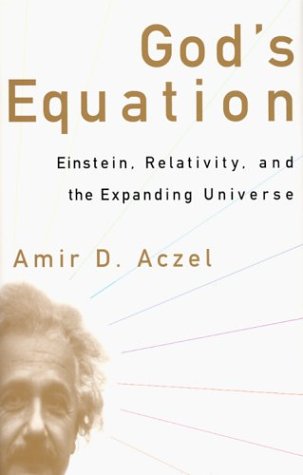
| Amazon.com Who would have thought a mathematical constant would make such an engaging character? God's Equation: Einstein, Relativity, and the Expanding Universe, mathematician Amir Aczel's tale of the search for a scientific explanation of the universe, features the cosmological constant in a role as complex as Einstein's. The great genius referred to it as his "greatest blunder," but recent events in the world of astrophysics have brought the prodigal term back into the fold as an important part of his field equation. Aczel is a powerful storyteller, and makes no secret of his admiration for Einstein; much of the book revolves around his conquest of general relativity. Integrating relativity with gravitation was no easy task (even for Einstein), but the author deftly steers the reader away from the sticky stuff and focuses attention on concepts of importance. Aczel shows Einstein's aesthetic troubles with the cosmological constant, which preceded theoretical and experimental problems leading to its abandonment. The universe was caught in the act of expansion by Edwin Hubble, and the constant, originally invoked to maintain a steady-state universe, was unnecessary. Fortunately, though, the mathematics underlying the constant had become important tools for physicists; observations in 1997 and 1998 by Saul Perlmutter, Neta Bahcall, and others showed that the universe will continue expanding indefinitely and sent theorists back to the drawing board to revise their equations. The cosmological constant returned triumphant, and while its inventor might never have approved of it, today's scientific community gives it an honored role in God's Equation. --Rob Lightner --This text refers to the Hardcover edition. From Publishers Weekly For decades, scientists have debated whether the universe will eventually collapse upon itself, will expand until it reaches an optimal size and remain steady, or will expand forever. To most everyone's surprise, studies of particular huge supernovae are providing evidence that the last possibility may be right and that billions of years from now the universe will be an unimaginably immense void of burned-out stars. The explanation for this may lie in the "cosmological constant," a part of Einstein's field equation for general relativity. Though Einstein described the constant as the greatest blunder of his career, many scientists now think that it could correctly represent some kind of "funny energy" pushing the universe apart. Aczel (Fermat's Last Theorem; Probability 1) contends that Einstein's equation for the cosmological constant is our best approximation of what he calls "God's equation": the ultimate summary of how the universe works. Though Aczel's analysis of Einstein's work requires familiarity with advanced mathematics, that analysis makes up only a minor portion of his book, and most readers will appreciate the author's inclusion of the great physicist's letters to astronomer Erwin Freundlich. Translated here for the first time, they give a glimpse of Einstein's ambition and of his occasional indifference toward collaborators who were no longer useful to him. Aczel's writing is marred by his proclivity to make hyperbolic statements ("Einstein became one of the greatest celebritiesApossibly the greatestAthe world has ever known"), and some of his historical observations are na?ve. Those fascinated by Einstein will find much of interest here, but general readers hungry for information about recent developments in cosmology may want to consult more accessible authors, such as John Gribbin (The Case of the Missing Neutrinos). Figures not seen by PW. (Oct.) Copyright 1999 Reed Business Information, Inc. --This text refers to the Hardcover edition. From Library Journal In this well-written book, Aczel (Fermat's Last Theorem: Unlocking the Secret of an Ancient Mathematical Problem) attempts to explain in lay terms the meaning and significance of Einstein's theory of relativity; to a large extent, he succeeds. He shows us how Einstein developed and modified the theory and how he interacted with others working in mathematics, physics, and astronomy. Aczel explains that Einstein proposed a mathematically elegant equation, based on physical, philosophical, and aesthetic considerations, whose solutions (if found) would describe the large-scale behavior of the universe. He then modified the equation by adding a cosmological constant, since his first solutions indicated that the universe must be expanding, and no physical evidence to that effect existed at the time. When it was later shown that the universe was indeed expanding, he removed the constant, calling it a mistake. Yet new evidence seems to show that even when he thought he was wrong, Einstein may have been rightAthe cosmological constant may be essential to our understanding of the universe. For public libraries.AHarold D. Shane, Baruch Coll., CUNY Copyright 1999 Reed Business Information, Inc. --This text refers to the Hardcover edition. From Booklist Einstein blundered? So he thought. So too did his colleagues in theoretical physics, who for decades dismissed Einstein's attempt to introduce a "cosmological constant" into his formula for the dynamics of the universe as an unfortunate and uncharacteristic misstep. But genius will out. In one of the most exciting scientific detective stories ever told, Aczel chronicles the stunning reversals in the evolution of physics that are fast converting Einstein's embarrassing error into yet another proof of his elusive brilliance. With the same lightness of touch he displayed in Fermat's Last Theorem (1996), Aczel guides ordinary mortals through the odyssey that made Einstein the world's premier scientist while still a young man and that culminated in his audacious attempt to formulate a unified field theory to link all the fundamental forces in the universe. Even readers without exceptional mathematical sophistication will grasp why Einstein first conceived of a cosmological constant and then later repudiated it as bad mistake. But Aczel's greatest accomplishment lies in his deft weaving together of the seemingly disparate research projects in cosmology and quantum physics that have unexpectedly provided fresh evidence for the validity of Einstein's cosmological constant as the key to understanding the "strange energy" filling quantum space and driving our universe ever outward. A marvelous distillation of epoch-making science. Bryce Christensen --This text refers to the Hardcover edition. From Kirkus Reviews In 1912, Albert Einstein wrote down an equation that describes the structure of the universe. But even he didnt recognize its full meaning. Aczel (Probability 1, 1998, etc.) has made a career of explaining the frontiers of mathematics. Here he tackles Einstein's field equation of general relativity not only in the context of modern physics, but in the history of mathematics. When Einstein began to incorporate gravity into his theories, he realized that it must have certain effects on light. In particular, light leaving a massive object would be red-shifted; its frequency would become longer, as if the object were moving away. Space was curved, and that curvature could be described in terms of non-Euclidean geometrybuilt on alterations of Euclid's fifth postulate, which after trying unsuccessfully to prove for two millennia, mathematicians decided to treat as an arbitrary and unprovable assumption. The curvature of space and its effect on light made possible experimental verifications of relativity: for example, the positions of stars seen near the sun in an eclipse should differ from their positions when the sun was in another part of the sky. In 1919, a British expedition led by Arthur Eddington measured those star positions and proved Einstein's theories correct. Meanwhile, Einstein had been exploring the cosmological implications of his theory, in particular the question of whether the universe expands, contracts, or remains the same size. Here, for the first time, he did not believe his own calculations and felt it necessary to add a ``cosmological constant'' to his field equationa fudge factor he later described as his greatest blunder when astronomers demonstrated that the universe was in fact expanding. More recent theorists suspect that the cosmological constant was needed, after allbut until another Einstein comes along, the field equation remains the closest thing we have to a divine blueprint for the universe. While the actual math is heavy going, Aczel gives a very readable account of the science and the scientists involved. -- Copyright ©1999, Kirkus Associates, LP. All rights reserved. --This text refers to the Hardcover edition. Book Description Are we on the verge of solving the riddle of creation using Einstein's "greatest blunder"? In a work that is at once lucid, exhilarating and profound, renowned mathematician Dr. Amir Aczel, critically acclaimed author of Fermat's Last Theorem, takes us into the heart of science's greatest mystery. In January 1998, astronomers found evidence that the cosmos is expanding at an ever-increasing rate. The way we perceive the universe was changed forever. The most compelling theory cosmologists could find to explain this phenomenon was Einstein's cosmological constant, a theory he conceived--and rejected---over eighty years ago. Drawing on newly discovered letters of Einstein--many translated here for the first time--years of research, and interviews with prominent mathematicians, cosmologists, physicists, and astronomers, Aczel takes us on a fascinating journey into "the strange geometry of space-time," and into the mind of a genius. Here the unthinkable becomes real: an infinite, ever-expanding, ever-accelerating universe whose only absolute is the speed of light. Awesome in scope, thrilling in detail, God's Equation is storytelling at its finest. --This text refers to the Paperback edition. Card catalog description "The product of research around the globe - and interviews with dozens of prominent scientists, God's Equation discusses the latest developments in cosmology, the study of the nature of the universe. Using Einstein and his theories to explain the links between relativity and cosmology via Einstein's "cosmological constant," Aczel tells us it is almost as though Einstein were God's mouthpiece, revealing the most fundamental truths about our larger environment, truths scientists are just now confirming."--BOOK JACKET. "And yet Aczel reveals a side of Einstein - the man - no one else has brought to light. Aczel is the first to have translated certain letters of Einstein, in private hands until recently. These letters cast a new spin on Einstein's relationship with other scientists and his early efforts to prove his revolutionary theory that a strong gravitational force will make light bend."--BOOK JACKET. --This text refers to the Hardcover edition. |
|
|
||||||||||||||||||||||||||||||||||||