| Almost Like a Whale - The Origin of Species UPDATED (1999) |
| Front Cover | Book Details | |||||||||||||
|
|
| Plot |
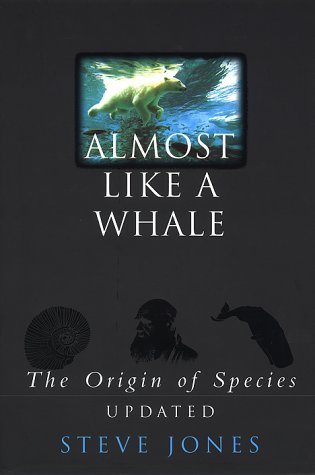
| Amazon.co.uk Review Steve Jones describes Darwin's The Origin of Species as "the only bestseller to change man's conception of himself ... without doubt, the book of the millennium." That book's sensational central proposition, that speciation arose from descent with modification through the mechanism of natural selection, constituted a kind of Grand Unifying Theory of the biological sciences, allowing what had been until Darwin's time an essentially anecdotal practice to cohere into a modern discipline. In the century and a half since its publication, Darwin's big idea has been attacked many times, on many grounds, but has never convincingly been refuted. Yet, as Jones points out, hardly anybody reads The Origin of Species now for its science. It is celebrated as a landmark in the history of ideas, as a contribution to the philosophy of science and as a masterly work of high Victorian prose. The idea of evolution has pervaded almost every aspect of human thought. But it has almost been forgotten that it is primarily a work of science. Almost like a Whale is an attempt to redress the balance. Jones, himself a geneticist, assumes the mantle of Darwin and rewrites his masterpiece for the modern reader, borrowing the structure and thesis but writing with the benefit of 150 years' hindsight. Throughout the 20th century new sciences have emerged that have in all cases buttressed the central claims of evolution, chief among them embryology and Jones' own discipline of genetics. Almost Like a Whale draws widely on them for its arguments and many illuminating stories and case- studies. It is a bold and ambitious project, carried off with considerable style and wit. Any suspicion of lightness is misplaced, though, as the seriousness and profundity of the underlying arguments are signalled early in the book: Jones destroys one of the main creationist objections to the theory of evolution--that no-one has ever seen it happen--with a devastating account of the well-documented 50-year evolution of the AIDS virus into its present varieties. The title is not a near-miss reference to Hamlet: it is Darwin himself, speculating on whether a bear seen swimming and catching food with its mouth as it swam, might represent the first, behavioural step on an evolutionary journey towards a new creature" almost like a whale." This is a powerfully entertaining book, engrossing in its science, erudite and cogent. --Robin Davidson Book Description The Language of the Genes and In the Blood revisits Darwin's The Origin of Species, and updates it for the twenty-first century. Synopsis Containing anecdotes, facts and humour, this work uses 20th-century science to update the theories presented in Darwin's "The Origin of Species". Book Information In his new book Steve Jones takes up the challenge of rewriting the book of the millennium. Charles Darwin's The Origin of Species. Before The Origin, biology was little more than a series of unconnected facts. Darwin makes it into a science, held together by his theory of evolution, the grammar of the living world. Darwin had only the facts of the 19th century to support his argument. Almost Like a Whale uses Darwin's logic, together with the astonishing discoveries of today, to make his case. It brings together the AIDS virus, dog shows, the sheep who never forget a face, the Battle of the Somme and the garbage that floats in the Pacific, to prove the fact of evolution. Filled with anecdotes, humour and the latest research, Almost Like a Whale is a popular account of the science that makes life make sense. It catches the millennial mood and tells all those for whom Darwin is merely a familiar name and some dimly remembered ideas exactly what he meant, and why we know he was right. It exposes the delusions of those who try-- and fail--to explain society in evolutionary terms, and it shows how humans became the first species to step beyond the constraints of biology. About the Author Steve Jones is Professor of Genetics at University College London and has worked at universities in the USA, Australia and Africa. He gave the BBC Reith Lectures in 1991, and presented a successful BBC TV series on human genetics and evolution in 1996. He is a regular columnist for the DailyTelegraph and frequently appears on radio and television. His previous books include Language of Genes (which won the 1994 Rhône-Poulenc Science Book Prize) and In the Blood (shortlisted for the 1997 Rhône-Poulenc). He has also received the Faraday Medal for the Public Understanding of Science. --Amazon.com From the Back Cover In his new book Steve Jones takes up the challenge of rewriting the book of the millennium, Charles Darwin's The Origin of Species. Before The Origin, biology was little more than a series of unconnected facts. Darwin made it into a science, held together by his theory of evolution, the grammar of the living world. Darwin had only the facts of the nineteenth century to support his argument. Almost Like a Whale uses Darwin's logic, together with the astonishing discoveries of today, to make his case. It brings together the AIDS cirus, dog shows, the sheep who never forget a face, the Battle of the Somme, and the garbage that floats in the Pacific, to prove the fact of evolution. Filled with anecdotes, humour and the latest research, Almost Like a Whale is a popular account of the science that makes life make sense. It catches the millennial mood and tells all those for whom Darwin is merely a familiar name and some dimly remembered ideas exactly what he meant, and why we know he was right. It exposes the delusions of those who try - and fail - to explain society in evolutionary terms, and it shows how humans became the first species to step beyond the constraints of biology. About the Author Steve Jones Jones is Professor of Genetics at University College London and has worked at universities in the USA, Australia and Africa. He gave the BBC Reith Lectures in 1991, and presented a successful BBC TV series on human genetics and evolution in 1996. He is a regular columnist for the Daily Telegraph and frequently appears on radio and television. His previous books include The Language of the Genes (which won the 1994 Rhône-Poulenc Science Book Prize) and In the Blood (shortlisted for the 1997 Rhône-Poulenc). He won the 1997 Royal Society Faraday Medal for the Public Understanding of Science. |
|
|
||||||||||||||||||||||||||||||||||||||||||||||||||||
| Notes |
| Presente de Aniversario da Cristina (2003) |