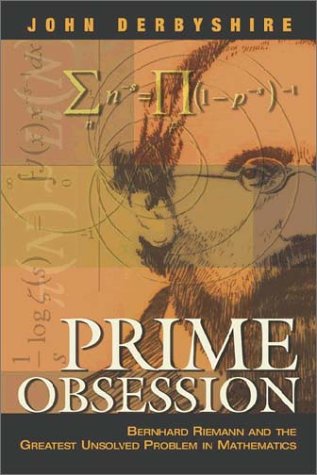
| Prime Obsession - Bernhard Riemann and the Greatest Unsolved Problem in Mathematics (2003) |
| Front Cover | Book Details | |||||||||||||
|
|
| Plot |
| Amazon.com Bernhard Riemann was an underdog of sorts, a malnourished son of a parson who grew up to be the author of one of mathematics' greatest problems. In Prime Obsession, John Derbyshire deals brilliantly with both Riemann's life and that problem: proof of the conjecture, "All non-trivial zeros of the zeta function have real part one-half." Though the statement itself parses as nonsense to anyone but a mathematician, Derbyshire walks readers through the decades of reasoning that led to the Riemann Hypothesis in such a way as to clear it up perfectly. Riemann himself never proved the statement, and it remains unsolved to this day. Prime Obsession offers alternating chapters of step-by-step math and a history of 19th-century European intellectual life, letting readers take a breather between chunks of well-written information. Derbyshire's style is accessible but not dumbed-down, thorough but not heavy-handed. This is among the best popular treatments of an obscure mathematical idea, inviting readers to explore the theory without insisting on page after page of formulae. In 2000, the Clay Mathematics Institute offered a one-million-dollar prize to anyone who could prove the Riemann Hypothesis, but luminaries like David Hilbert, G.H. Hardy, Alan Turing, André Weil, and Freeman Dyson have all tried before. Will the Riemann Hypothesis ever be proved? "One day we shall know," writes Derbyshire, and he makes the effort seem very worthwhile. --Therese Littleton From Booklist Bernhard Riemann would make any list of the greatest mathematicians ever. In 1859, he proposed a formula to count prime numbers that has defied all attempts to prove it true. This new book tackles the Riemann hypothesis. Partly a biography of Riemann, Derbyshire's work presents more technical details about the hypothesis and will probably attract math recreationists. It requires, however, only a college-prep level of knowledge because of its crystalline explanations. Derbyshire treats the hypothesis historically, tracking increments of progress with sketches of well-known people, such as David Hilbert and Alan Turing, who have been stymied by it. Carrying a million-dollar bounty, the hypothesis is the most famous unsolved problem in math today, and interest in it will be both sated and stoked by these able authors. Gilbert Taylor Copyright © American Library Association. All rights reserved John F. Nash, Jr., 1994 Nobel Prize Winner in Economics "A remarkable book." The Christian Science Monitor, April 10, 2003 "The most detailed, and consequently the most rewarding account ... a math book that reads like a mystery novel." The New Criterion, April 2003 "...Derbyshire is a talented expositor determined to make the reader understand some serious mathematics." Book Description In August 1859 Bernhard Riemann, a little-known 32-year old mathematician, presented a paper to the Berlin Academy titled: "On the Number of Prime Numbers Less Than a Given Quantity." In the middle of that paper, Riemann made an incidental remark -- a guess, a hypothesis. What he tossed out to the assembled mathematicians that day has proven to be almost cruelly compelling to countless scholars in the ensuing years. Today, after 150 years of careful research and exhaustive study, the question remains. Is the hypothesis true or false? Riemann’s basic inquiry, the primary topic of his paper, concerned a straightforward but nevertheless important matter of arithmetic--defining a precise formula to track and identify the occurrence of prime numbers. But it is that incidental remark -- the Riemann Hypothesis -- that is the truly astonishing legacy of his 1859 paper. Because Riemann was able to see beyond the pattern of the primes to discern traces of something mysterious and mathematically elegant shrouded in the shadows--subtle variations in the distribution of those prime numbers. Brilliant for its clarity, astounding for its potential consequences, the Hypothesis took on enormous importance in mathematics. Indeed, the successful solution to this puzzle would herald a revolution in prime number theory. Proving or disproving it became the greatest challenge of the age. It has become clear that the Riemann Hypothesis, whose resolution seems to hang tantalizingly just beyond our grasp, holds the key to a variety of scientific and mathematical investigations. The making and breaking of modern codes, which depend on the properties of the prime numbers, have roots in the Hypothesis. In a series of extraordinary developments during the 1970s, it emerged that even the physics of the atomic nucleus is connected in ways not yet fully understood to this strange conundrum. Hunting down the solution to the Riemann Hypothesis has become an obsession for many -- the veritable "great white whale" of mathematical research. Yet despite determined efforts by generations of mathematicians, the Riemann Hypothesis defies resolution. Alternating passages of extraordinarily lucid mathematical exposition with chapters of elegantly composed biography and history, Prime Obsession is a fascinating and fluent account of an epic mathematical mystery that continues to challenge and excite the world. Posited a century and a half ago, Riemann’s hypothesis is an intellectual feast for the cognoscenti and the curious alike. Not just a story of numbers and calculations, Prime Obsession is the engrossing tale of a relentless hunt for an elusive proof -- and those who have been consumed by it. From the Inside Flap "John Derbyshire's tour de force Prime Obsession guides one through a 200-year-long story of the world's best-known, unsolved mathematical mystery. The formulation, study, and significance of the Riemann hypothesis each represent immense areas of mathematical thought; this book expertly tackles them all. The chapters filled with anecdotes alternate with chapters that lead the novice gently by hand into the exploration of fundamental ideas -- captivating the reader and creating a lasting impression." -- Arthur Jaffe, Harvard University "The Riemann Hypothesis is one of the deepest of all unsolved problems in mathematics. Unfortunately it is difficult to state exactly what the hypothesis is. It is high time that someone would write a book explaining the hypothesis in ways understandable by ordinary mathematicians and even by laymen. Three cheers to John Derbyshire for having finally done it." -- Martin Gardner, "Mathematical Games" columnist for Scientific American and author of Did Adam and Eve Have Navels? "An informative, comprehensive, well written account of the unsolved problem that most mathematicians regard as the most important open problem in the field. Derbyshire not only tells the historical story behind the problem -- the people stuff -- he also includes all the mathematics needed to understand what the problem is about and how people are trying to solve it." -- Keith Devlin, Stanford University, author of The Millennium Problems: The Seven Greatest Unsolved Mathematical Puzzles of Our Time About the Author John Derbyshire is a mathematician and linguist by education, a systems analyst by profession, and a celebrated writer in his spare time. He is best known as the author of Seeing Calvin Coolidge in a Dream, the highly acclaimed 1996 novel that was extravagantly praised by Jonathan Yardley in the Washington Post Book World and uniformly well reviewed in the The New York Times Book Review, the New Yorker, and the Boston Globe, among others. His work appears frequently in National Review and The New Criterion. Born and raised in England, he has made his home in the U.S. for the past 15 years. He currently lives in Huntington, New York, with his wife and two children. |
|
|
||||||||||||||||||||||||||||||||||||||||||||||||||
| Original Details | |
| Original Publication Year | 2003 |